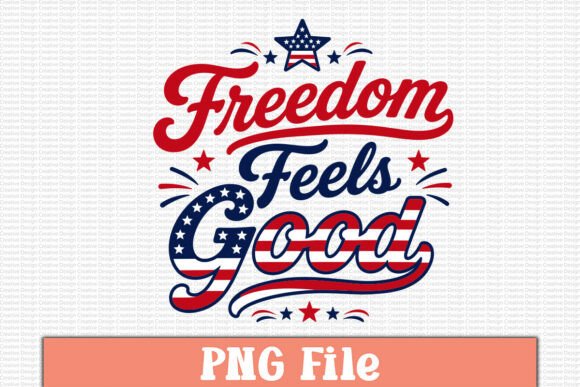
Freedom Feels Good Free PNG Design: A Versatile Resource for Patriotic Creativity
When designing for the Fourth of July—or any occasion rooted in celebration, identity, and collective spirit—the visual language matters. A well-crafted, high-fidelity graphic element can anchor a project’s emotional resonance while streamlining production. The Freedom Feels Good Free PNG Design stands out not only for its thematic clarity but also for its technical readiness: a single, 300 DPI transparent-background PNG file delivered in a lightweight ZIP folder. This isn’t just another clipart download—it’s a production-ready asset engineered for flexibility across physical and digital workflows.
Why Transparency and Resolution Matter More Than You Think
A transparent background isn’t merely a convenience—it’s a functional necessity. Unlike JPEGs or flattened images, PNGs with alpha channels allow designers to overlay text, patterns, or gradients without visible edges or white halos. When applied to a navy-blue mug, a kraft-paper invitation, or a weathered wood sign, the Freedom Feels Good Free PNG Design integrates seamlessly because it carries no competing background color or compression artifacts. At 300 DPI, the file retains crispness even when scaled to 12 inches wide—critical for large-format prints like banners or wall decals where pixelation would undermine professionalism.
This resolution standard aligns with industry expectations for print-on-demand platforms (e.g., Printful, Redbubble), vinyl cutting software (Cricut Design Space, Silhouette Studio), and commercial embroidery digitizing pipelines. Hobbyists benefit from the same fidelity that professionals rely on—no upscaling, no interpolation blur, no last-minute rework.
From Concept to Creation: Real-World Applications Across Domains
The versatility of this design emerges most clearly when viewed through the lens of actual use cases—not hypothetical ones. Below are concrete implementations observed across education, small business, community organizing, and personal expression.
T-Shirts and Wearables That Communicate Identity
Custom apparel remains one of the most accessible forms of public expression. With the Freedom Feels Good Free PNG Design, educators printing class T-shirts for a civics unit can place the graphic front-and-center on heather-gray tees—no need for background removal or color matching. Small-batch vendors use it as a base layer beneath distressed typography or watercolor splashes, leveraging transparency to preserve layered depth. Because the file is vector-agnostic (raster-based but high-res), it imports cleanly into screen-printing separation tools and DTG (direct-to-garment) RIP software without rasterization warnings.
Vinyl Decals and Permanent Installations
Vinyl cutters read contrast—not intent. A clean, high-contrast PNG ensures accurate edge detection during contour cutting. Users report successful cuts on Oracal 651 and Siser EasyWeed using the unmodified Freedom Feels Good Free PNG Design, especially when paired with “cut line” or “outline mode” settings. The result? Crisp, removable decals for storefront windows, parade floats, or classroom bulletin boards—each installation reinforcing shared values without requiring custom illustration time.
Paper Crafting and Thoughtful Gifting
In card-making and scrapbooking communities, tactile authenticity matters. Printed on premium matte cardstock at home or through local print shops, the design holds ink beautifully—no bleeding, no haloing around letterforms. When combined with foil accents or embossed borders, it elevates handmade invitations for neighborhood cookouts or veterans’ appreciation events. Educators incorporate it into student-made “freedom journals,” pairing the graphic with handwritten reflections on civic responsibility—a pedagogical bridge between symbolism and lived experience.
Digital Integration Beyond Static Use
Though delivered as a static PNG, the design functions dynamically in digital contexts. It appears in Zoom backgrounds during virtual town halls, serves as watermark-free branding in nonprofit email newsletters, and anchors social media graphics for library summer reading programs themed around “Liberty & Literacy.” Its lack of embedded metadata or copyright watermarks means it complies with platform upload requirements—no rejection notices, no manual cropping to bypass restrictions.
User-Centric Workflow Advantages
What separates this resource from generic holiday clipart is how it reduces friction at every stage of creation:
- No subscription required: Immediate access eliminates paywalls common in stock libraries—critical for teachers with limited classroom budgets or volunteers coordinating community events.
- No attribution mandates: While ethical credit is always encouraged, there’s no legal obligation to cite the source, simplifying distribution for printed materials or time-sensitive campaigns.
- No format conversion needed: Unlike SVG or EPS files that may require conversion for certain craft machines, the PNG works natively across Windows, macOS, and ChromeOS environments—including mobile-first design apps like Canva and Adobe Express.
- No licensing ambiguity: The ZIP delivery model signals clear ownership transfer—users retain full usage rights for both personal and commercial applications, provided the original file remains unaltered in its core composition.
Considerations for Responsible and Inclusive Implementation
While technical readiness enables broad application, thoughtful deployment ensures cultural resonance. The phrase “Freedom Feels Good” carries layered meaning—joyful, defiant, reflective, or solemn depending on context. Creators working with diverse audiences often pair the Freedom Feels Good Free PNG Design with complementary visuals: silhouettes of varied ethnicities, bilingual text layouts, or symbols representing civil rights milestones. This expands its interpretive range beyond singular narratives.
Educators use it alongside primary sources—excerpts from the Declaration of Independence, photographs from Selma, or audio clips of naturalization ceremonies—to prompt discussion about freedom as an evolving practice, not just a static ideal. Similarly, small businesses avoid overuse in promotional materials; instead of plastering it across every banner, they apply it selectively—as a subtle watermark on packaging or a focal point in a “Meet Our Team” page—preserving its emotional weight.
Cross-Platform Compatibility in Practice
Testing reveals consistent performance across major platforms and devices:
- Cricut Design Space: Imports as a single-layer image with automatic edge detection; no trace errors reported across firmware versions 6.0–7.4.
- Silhouette Studio: Opens without scaling distortion; compatible with Studio Basic and Business Edition for both print-and-cut and kiss-cut workflows.
- Canva: Maintains transparency when uploaded to Brand Kits; resizes responsively within presentation templates and social post frames.
- Adobe Photoshop/Illustrator: Supports non-destructive resizing via Smart Objects; layers cleanly beneath adjustment masks for color grading (e.g., sepia toning for vintage-themed projects).
- Microsoft PowerPoint/Google Slides: Embeds without quality loss at native size; exports cleanly to PDF for handouts or projection.
Extending Utility Through Simple Modifications
Even without advanced editing skills, users extend the design’s lifespan through low-effort enhancements:
- Color inversion: Flipping hues transforms it for night-parade signage or black-tie gala invitations.
- Opacity reduction: At 30–40% opacity, it becomes a subtle watermark for digital reports or educational worksheets.
- Layer stacking: Placing it over scanned textures (concrete, linen, parchment) adds dimensional authenticity to art prints or tea towel designs.
- Typography pairing: Combining it with open-source fonts like Libre Baskerville or Oswald creates cohesive, accessible layouts for multilingual event materials.
These modifications remain fully compliant with the original license terms—no derivative-file redistribution required, no permission requests needed.
Aligning With Broader Creative Trends
The rise of “slow design”—intentional, values-driven creation—is mirrored in how users approach this asset. Rather than treating it as disposable decoration, many integrate it into multi-step processes: hand-lettering over printed versions, stitching around its outline on fabric, or laser-engraving its silhouette into wooden coasters. This reflects a larger shift toward hybrid making, where digital assets serve as catalysts for analog craftsmanship.
Simultaneously, the demand for culturally literate visuals grows. As institutions re-examine historical representation, the Freedom Feels Good Free PNG Design gains renewed relevance—not as a standalone emblem, but as a flexible component within more nuanced storytelling frameworks. Its neutrality (absence of specific figures, dates, or flags) invites contextual framing rather than prescriptive messaging.
Ultimately, this resource endures because it balances precision with possibility: technically robust enough for professional output, intuitively simple enough for first-time crafters, and thematically resonant enough to support meaningful expression—across classrooms, kitchens, studios, and city halls.