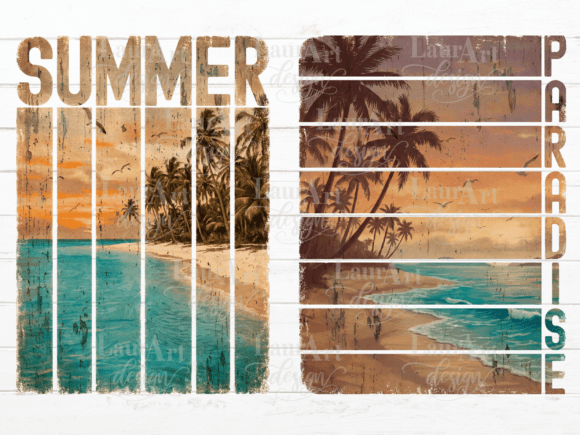
Vintage Summer Poster Brushstroke Summer
When you’re designing for summer—whether it’s a boutique product line, a seasonal marketing campaign, or a personal creative project—the Vintage Summer Poster Brushstroke Summer digital asset serves as both a starting point and a finishing touch. It’s not just decoration; it’s a functional design element built for integration into real-world production workflows. Unlike generic clipart or low-resolution web graphics, this item arrives ready for professional output: two high-resolution PNG files (300 dpi, 5400 px on the longest side), delivered in a single ZIP folder, with transparent backgrounds and precise edge definition.
Where This Design Fits in Your Workflow
The Vintage Summer Poster Brushstroke Summer sits most naturally in the *production phase* of visual projects—but its value extends earlier and later in the process too. Before finalizing a layout in Canva, Adobe Express, or Illustrator, you can drop the PNG into a mockup to test scale, color harmony, and visual weight. During sublimation prep for mugs, tote bags, or apparel, its transparency eliminates clipping masks and speeds up layer alignment. After printing, its brushstroke texture adds tactile authenticity that flat vector icons often lack—making it especially effective for artisanal or nostalgic branding.
Because it’s raster-based—not vector—it doesn’t scale infinitely, but that limitation is intentional. At 5400 px wide, it holds crisp detail even when printed at 18 inches on the longest side. That makes it ideal for large-format applications like wall decals, event backdrops, or framed prints—provided you match output size to resolution. You won’t need to trace or redraw it for screen printing or heat transfer; instead, you import, position, and output directly.
Compatibility and Tool Integration
This design works seamlessly with tools that support transparent PNGs and Print-and-Cut functionality. If you use a Cricut Maker, Silhouette Cameo, or Brother ScanNCut, you can print the image on sticker paper or vinyl and let the machine cut precisely along its outer edges—no manual tracing required. In Photoshop or Affinity Photo, you can adjust hue, brightness, or contrast non-destructively using adjustment layers. For educators or small business owners building branded social templates, it slots cleanly into Canva’s drag-and-drop editor without background cleanup.
Note: Because it’s not a vector file, you can’t edit individual strokes or letters as separate paths. But that’s rarely necessary for its intended use cases. Most users apply global adjustments—softening edges for a faded poster look, overlaying subtle grain for analog texture, or blending modes to integrate with photo backgrounds. Those edits happen quickly in raster editors and preserve fidelity across repeated use.
Practical Implementation Tips
- Sublimation Prep: When prepping for sublimation, place the PNG on a white background layer before exporting your final print file. This ensures no unintended transparency affects ink coverage on polyester substrates.
- Cutting Machine Setup: Use the “Print & Cut” registration marks feature. Import the PNG, set cut lines to “auto-detect edges,” and run a test cut on scrap material first—especially if using textured or thick media.
- Brand Consistency: Save a version with your brand’s primary accent color applied via Hue/Saturation adjustment. Store it alongside your logo assets so team members pull from the same consistent palette.
- Watermarking for Physical Use: As noted in the product details, watermarking is required when applying this design to physical products you sell. Add a subtle, semi-transparent text overlay (e.g., your shop name at 15% opacity, bottom corner) before final export. This protects your licensing rights while preserving visual integrity.
Workflow Examples Across Roles
A freelance graphic designer might use Vintage Summer Poster Brushstroke Summer as a base layer for a client’s summer farmers’ market banner—overlaying hand-lettered copy and local photography on top. The brushstroke texture bridges the gap between illustrative and photographic elements, giving cohesion without competing for attention.
An educator preparing summer learning kits could insert the design into a printable activity sheet header. Its nostalgic tone signals “fun, relaxed learning”—a psychological cue that supports engagement before students even read the instructions. Paired with editable text fields in PDF form software, it becomes part of a reusable template system.
A small-batch candle maker uses it on labels for limited-edition citrus-scented jars. They import the PNG into their label printer software, scale it to fit the 3×2 inch label area, then add scent name and burn time in a complementary serif font. Because the design already carries strong seasonal association, minimal extra styling is needed—cutting down on design iteration time.
Quality Control and Long-Term Use
Before mass production, always check three things: color accuracy on your target device (calibrate your monitor or soft-proof for CMYK if offset printing), edge sharpness at final output size (zoom to 100% view in your editing software), and watermark visibility if applicable (test print on actual substrate, not just screen). These checks take under five minutes but prevent costly reprints or brand misalignment.
For long-term organization, store the original ZIP file in a dedicated “Seasonal Assets” folder with clear naming: VintageSummerBrushstroke_2024_v1.zip. Keep edited versions separately—e.g., VintageSummer_Brightened_CutReady.png—so the source remains untouched for future adaptations. This simple habit avoids version confusion when revisiting projects months later.
Efficiency Gains You’ll Notice Immediately
Designers report cutting layout time by 30–50% when using purpose-built assets like Vintage Summer Poster Brushstroke Summer, compared to sourcing, editing, and aligning multiple disparate elements. There’s no hunting for matching fonts or textures—the brushstroke style, color balance, and composition are already resolved. That means more time spent on messaging, audience targeting, or user testing—and less time troubleshooting alignment or pixelation.
It also reduces decision fatigue. When you know an asset reliably delivers quality at known dimensions and use cases, you stop asking “Will this work?” and start asking “How best can I apply it?” That shift—from uncertainty to execution—is where real workflow momentum builds.
Final Considerations for Real-World Use
Remember: this is a digital item meant to accelerate output—not replace thoughtful design judgment. Its strength lies in specificity. It won’t suit every summer project (e.g., minimalist tech branding or corporate retreat materials), and that’s by design. Use it where warmth, nostalgia, and handmade texture reinforce your goal—not where they distract from it.
If you’re evaluating whether it fits your current task, ask: Does my audience respond to vintage aesthetics? Am I producing something physical—or preparing files for physical output? Do I need high-resolution raster clarity at 18-inch scale? If two of those are yes, Vintage Summer Poster Brushstroke Summer likely belongs in your active toolkit.
And because it arrives pre-optimized—with transparency, resolution, and edge definition handled—you skip the common raster pitfalls: jagged edges, muddy colors, or mismatched DPI settings. That reliability compounds over time: one asset, reused across seasons, across clients, across platforms—without rework.