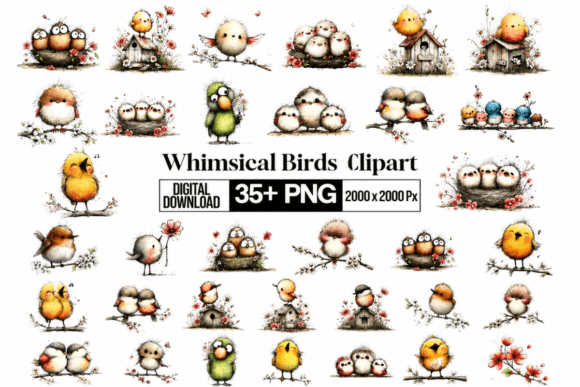
Whimsical Cute Birds Clipart
Whimsical Cute Birds Clipart isn’t just decorative—it’s a strategic visual tool. When chosen with intention, these designs do more than add charm: they shape tone, reinforce messaging, and quietly guide how audiences perceive your work. For professionals who rely on clarity, consistency, and emotional resonance—whether launching a brand, designing learning materials, or building a cohesive social presence—the right clipart supports outcomes, not just aesthetics.
Why Whimsical Cute Birds Clipart Works Where It Matters
These aren’t generic bird illustrations. Professionally crafted Whimsical Cute Birds Clipart features soft lines, balanced proportions, gentle color palettes, and expressive details—designed to evoke warmth without sacrificing polish. That distinction matters in practice. A hand-drawn robin with a tiny bowtie communicates playfulness *and* care; a minimalist hummingbird mid-hover suggests lightness and precision. These subtle cues align with goals like building trust in educational content, softening the tone of wellness branding, or adding approachability to customer-facing templates.
Unlike stock graphics that compete for attention, Whimsical Cute Birds Clipart is calibrated for harmony—not distraction. That makes it especially effective in contexts where visual hierarchy must remain intact: digital newsletters, printable planners, presentation decks, or product packaging. Because each piece is delivered as a high-resolution PNG with transparent backgrounds, it integrates cleanly—no pixelation, no awkward cropping, no compromise on fidelity across devices or print formats.
Strategic Use Cases Across Real-World Roles
How you apply Whimsical Cute Birds Clipart depends less on the clipart itself and more on your objective. Here’s how thoughtful practitioners use it:
- Entrepreneurs & small business owners embed these birds into service packages, welcome emails, or subscription thank-you pages—not to “make things cute,” but to signal personality and human-centered values before the first conversation begins.
- Educators and curriculum designers use them as consistent visual anchors in lesson slides, worksheets, or classroom posters. A recurring bird motif helps learners orient themselves across topics—especially useful for neurodiverse students who benefit from predictable, low-stimulus visual cues.
- Freelancers and creatives build branded asset libraries around Whimsical Cute Birds Clipart. One illustrator uses a custom sparrow series across her proposal templates, invoice headers, and client feedback forms—creating continuity that reinforces professionalism without requiring custom illustration for every touchpoint.
- Bloggers and content marketers deploy them as section dividers, callout icons, or visual metaphors (e.g., a nesting bird beside “foundations” in a strategy post). Done sparingly and consistently, this strengthens scannability and retention—particularly in long-form guides where visual rhythm affects engagement.
What to Consider Before You Integrate
Not every project benefits from whimsy—and that’s by design. Whimsical Cute Birds Clipart serves best when it complements, rather than contradicts, your audience’s expectations and your message’s weight. A legal firm’s compliance checklist likely doesn’t need a chirping finch—but their internal onboarding guide might, if the goal is to reduce anxiety and increase completion rates among new hires.
Ask yourself three questions before selecting or placing any piece:
- Does this support a specific outcome? (e.g., improving readability, reducing bounce rate, reinforcing brand voice)
- Is the tone aligned—not just with your brand, but with the user’s context? (A playful bird feels reassuring in a mental health app’s journaling prompt; it may feel dismissive in a crisis resource page.)
- Will it scale meaningfully? (One bird icon works. Ten unrelated ones dilute impact. Consistency in style, size, and placement builds recognition over time.)
Relying on Whimsical Cute Birds Clipart without answering those questions risks visual noise—distracting users, weakening credibility, or unintentionally flattening nuance. The risk isn’t in the clipart itself, but in deploying it without alignment to purpose.
How to Build Long-Term Value From a Single Collection
A growing collection of Whimsical Cute Birds Clipart offers compounding utility—if treated as a system, not a grab bag. Start by identifying one core use case: perhaps email headers for your newsletter. Choose three birds—one for “new ideas,” one for “deep dives,” one for “practical tips”—and use them consistently. Over six months, subscribers begin associating each bird with content type. That’s not decoration; that’s visual information architecture.
From there, extend the logic: reuse the same birds in matching Canva templates, Notion dashboards, or printed workshop handouts. Because all files are high-resolution PNGs with transparent backgrounds, resizing and layering require no technical overhead. And because new designs are added regularly, you can refresh seasonal campaigns without rebuilding entire visual systems.
This approach transforms clipart from a one-off purchase into an operational asset—reducing decision fatigue, speeding up design cycles, and maintaining coherence across channels where resources are tight and timelines are real.
Intentional Integration, Not Random Placement
There’s a difference between using Whimsical Cute Birds Clipart and leveraging it. Leveraging means treating each placement as a deliberate choice with measurable intent. It means testing whether a bird icon next to a “schedule a call” button increases click-through—or whether replacing a generic bullet point with a tiny wren improves comprehension in a step-by-step tutorial.
It also means knowing when *not* to use it. In data-heavy reports, accessibility-critical interfaces, or formal regulatory documents, restraint preserves clarity and meets functional standards. Whimsical Cute Birds Clipart excels at humanizing—not obscuring.
For creators managing multiple clients or projects, maintaining a simple usage log helps: note where a bird appears, why it was placed there, and what result followed (even qualitatively—e.g., “client said the mood felt ‘calm but capable’”). Over time, patterns emerge: certain species resonate more in wellness contexts; others perform better in productivity tools. That insight becomes part of your creative methodology—not just your asset library.
Support That Grows With Your Needs
Professional clipart isn’t static—and neither is your work. If your brand evolves, your audience shifts, or a campaign demands something beyond the current collection, direct access to custom support changes what’s possible. Need a bird holding a specific object? Matching your brand’s secondary palette? Adapted for left-to-right or right-to-left layouts? Those aren’t exceptions—they’re part of how thoughtful design scales.
That responsiveness matters most when timing is critical: launching a teacher resource during back-to-school season, preparing investor materials ahead of a funding round, or refreshing a Shopify theme before holiday traffic spikes. Knowing help is available—and rooted in understanding your goals—removes friction from execution without compromising quality.
Whimsical Cute Birds Clipart, at its best, functions like a fluent collaborator: quiet enough to stay out of the way, distinct enough to be memorable, and flexible enough to adapt—not to trends, but to your evolving priorities.