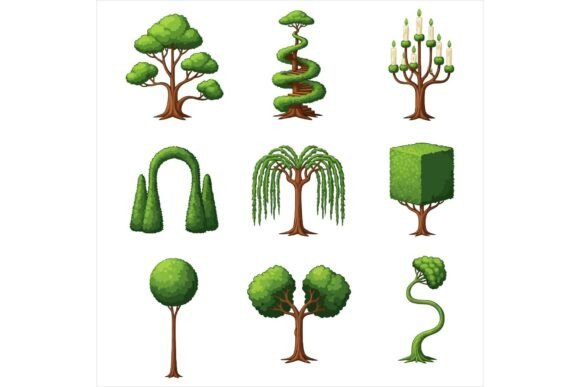
Free Collection of Various Cartoon Trees
If you’ve ever scrolled through design marketplaces searching for playful, versatile, and production-ready botanical assets—only to land on overused clipart or low-res PNGs—you’ll appreciate what this Free Collection of Various Cartoon Trees delivers. It’s not just another bundle of generic illustrations. These are thoughtfully drawn, expressive cartoon trees—each with distinct personalities: a winking oak with rosy cheeks, a lanky palm swaying mid-air, a grumpy-looking birch holding tiny sunglasses, even a giggling willow with curly branches that look like they’re dancing. They’re cheerful without being cloying, stylized without sacrificing clarity, and consistently balanced in weight, proportion, and visual rhythm.
The set leans into warm, accessible illustration—not hyper-realism or minimalist abstraction—but something closer to the kind of hand-drawn charm you’d find in indie children’s books, cozy café branding, or thoughtful greeting card design. Think rounded terminals, gentle line variation, subtle asymmetry, and intentional imperfections (like a slightly crooked trunk or uneven leaf clusters) that keep things human and inviting. There’s no forced “cuteness” here—just sincerity in shape and expression. That authenticity makes them work across audiences: equally at home on a toddler’s onesie as on a boutique coffee shop’s seasonal menu board.
Where These Cartoon Trees Actually Shine
This isn’t a one-trick asset library. Because each tree is delivered as a vector-based EPS file with transparent background—and backed up by high-resolution 300 DPI JPGs—the collection scales cleanly from thumbnail social posts to large-format wall art. No pixelation. No jagged edges. No background cleanup needed.
You’ll find these trees landing naturally in contexts where warmth, approachability, and visual storytelling matter most:
- Print-on-Demand businesses: T-shirts, hoodies, and tote bags benefit from their bold outlines and confident negative space—they hold up beautifully when screen-printed or heat-pressed, even at smaller sizes.
- Editorial and packaging design: A single cartoon tree can anchor a book cover, label, or recipe card without overwhelming text or competing with photography.
- Digital marketing assets: Social media banners, email headers, and Instagram story stickers gain instant friendliness with minimal effort—no need to layer effects or adjust contrast.
- Brand identity systems: Used as secondary motifs alongside a primary logo, they reinforce tone—especially for eco-conscious brands, wellness studios, or educational platforms focused on growth, nature, or nurturing.
What sets them apart from other “cute tree” packs is how well they integrate. Their consistent stroke weight, shared color logic (even when used in monochrome), and uniform baseline alignment mean mixing multiple trees in one layout feels intentional—not haphazard.
Designing With Intention, Not Just Decoration
It’s easy to drop an illustration into a layout and call it done. But strong design happens when every element supports function and feeling. These cartoon trees work because they’re built with hierarchy in mind: their shapes read clearly at a glance, their proportions allow breathing room around typography, and their transparency means they adapt seamlessly to any background—light, dark, textured, or photographic.
For example, placing one of the taller trees beside a headline doesn’t compete—it frames. Using a smaller, rounder version as a bullet icon in a presentation slide adds visual punctuation without distraction. And because all files include vectors, you can tweak individual leaves or branches in Illustrator if your project demands custom tweaks—something raster-only bundles simply won’t allow.
They also support consistency across touchpoints. If you’re building a brand system for a gardening blog or a sustainable stationery line, using the same tree family across your website, newsletter, and product tags creates quiet recognition—no logo required. That kind of cohesion builds trust faster than flashy graphics ever could.
Practical Tips Before You Use Them
Before downloading or dropping these into your next project, consider a few real-world checks:
- Match scale to context: A tall, detailed tree works on a poster but may clutter a mobile app icon. Try scaling down first and checking legibility—do the key features (face, trunk curve, branch gesture) still read?
- Test contrast in real environments: Drop the transparent PNG onto your actual background—whether it’s a soft beige Shopify banner or a vibrant gradient Instagram story—and verify readability. Sometimes subtle shadows or light strokes help separation.
- Pair wisely with type: These trees lean friendly and informal, so pair them with typefaces that share that energy—think rounded sans serifs (like Quicksand or Nunito) or warm, open serif fonts (like Merriweather or Lora). Avoid ultra-thin or rigid geometric fonts unless you’re aiming for deliberate irony.
- Check licensing scope: Yes, this is a free collection—but confirm whether commercial use (including POD sales) is explicitly permitted. The description confirms it is, which matters if you’re selling mugs or stickers. Always retain proof of license terms for your records.
Also worth noting: while the EPS files give full editing control, the JPGs are ideal for quick mockups or platforms that don’t accept vector uploads (like some e-commerce templates or basic Canva projects). Having both formats saves time without compromising quality.
A Quietly Powerful Design Asset
Great design assets don’t shout. They settle in, do their job, and leave space for your message—or your customer’s experience—to breathe. That’s what makes the Free Collection of Various Cartoon Trees quietly powerful. They’re not trying to be everything. They’re designed to be *enough*: enough personality to engage, enough clarity to communicate, enough flexibility to adapt.
Whether you’re sketching a concept for a client, prepping assets for your Etsy shop, or refreshing your blog’s visual voice—these trees offer a grounded, joyful starting point. No over-engineering. No stylistic whiplash. Just honest, well-crafted illustration, ready when you are.